
Knowledge Tracing is a well-known problem in AI for Education. It consists of monitoring how the student's knowledge changes during the learning process and accurately predicting their performance in future exercises. But how can we improve the current methods and overcome heir limitations?
In recent years, many advances have been made thanks to various machine learning and deep learning techniques. However, they have some pitfalls, such as modelling one skill at a time, ignoring the relationships between different skills, or inconsistent predictions, i.e. sudden spikes and falls across time steps.
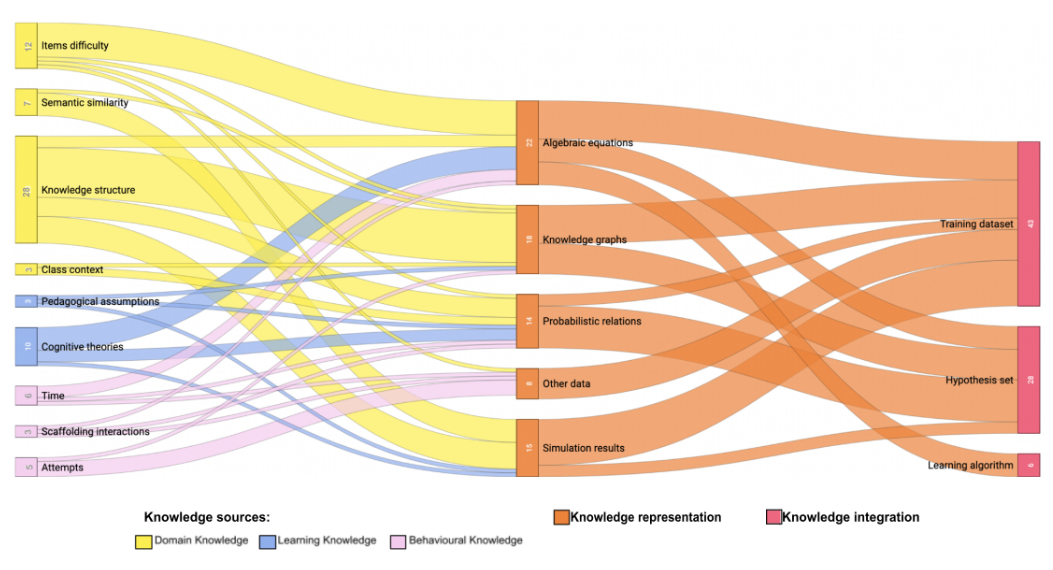
In our recently published systematic literature review, we aim to illustrate the state of the art in this field. Specifically, we want to identify the potential and the frontiers in integrating prior knowledge sources in the traditional machine learning pipeline to supplement the normally considered data. We propose a taxonomy with three dimensions: knowledge source, knowledge representation, and knowledge integration. We also conduct a quantitative analysis to detect the most common approaches and their advantages and disadvantages.
Our work provides a comprehensive overview of the hybrid machine-learning techniques for Knowledge Tracing and highlights the benefits of incorporating prior knowledge sources in the learning process. We believe this can lead to more accurate and robust predictions of student performance and help design more effective and personalized learning interventions. However, we also acknowledge that many challenges and open questions still need to be addressed, such as how to select the most relevant and reliable knowledge sources, how to represent and integrate them in a meaningful way, and how to evaluate their impact on the learning outcomes.
We hope that our work can inspire more research and innovation in the field of Knowledge Tracing and AI for Education.
Zanellati, A., Di Mitri, D., Gabbrielli, M., & Levrini, O. (2023). Hybrid Models for Knowledge Tracing: A Systematic Literature Review. IEEE Transactions on Learning Technologies, 1–16. doi: 10.1109/TLT.2023.3348690
https://ieeexplore.ieee.org/document/10379123