CategoriesConferences

Reflections about LAK26 and where the field is heading

I was lucky this week to attend the Learning Analytics '26 conference in Bergen, Norway. This year's conference focused on the synergies between LA and Generative AI. This shift to GenAI has intensified in the last few years. The collection of data from more traditional sources, such as LMS logs or visualisations in the LA dashboard, has been replaced by efforts to capture how and to what extent students learn with GenAI.

This shift is also reflected in the workshop topics. For instance, in the CROSSMMLA workshop, we explored GenAI as a "sensor for semantics" that can be integrated with a variety of modalities to analyse the learning process and add a layer of deeper understanding to typically structured and messy multimodal data.

Since my first LAK in 2016, I have been eagerly following the development of the field, while generally being quite positive yet critical of the research community's openness to new, theory-informed, technically rich approaches.

This year, however, the progressive shift towards GenAI at LAK left me not with enthusiasm but with a sense of unsettlement about the field.

First of all, there is the realisation that scientific discourse has pivoted almost exclusively toward how to make LLMs work for specific educational purposes, regardless of whether they are suitable or convenient to use over more parsimonious approaches. This includes how to train, fine-tune, and, more generally, "tame" LLMs, as well as how to deal with their side effects, such as fabricated results and incorrect information.

But very few of these works have addressed why these systems should be used in the first place, nor have they explored the broader consequences of using LLMs, e.g., resource exploitation, data labour by underpaid workers, and copyright infringement.

The dominant scientific imperative is to use LLMs as a research method, regardless of the results they produce, whether their use offers an actual advantage for students, learners, or a more powerful scientific approach.

It seems to me that science is also a victim of the hype rhetoric that either uses GenAI or is left behind. It is sad but true to admit that LA research is slowly being swept away by GenAI.

The critique of GenAI and the economy of hyperscale is probably an ethical dilemma I see, while many fellow scientists don't see it as an ethical problem at all.

Adapting to GenAI is imperative in the current era, where LLM use is pervasive, and adoption is unprecedented. While I see that this technology is here to stay, I am not blindly buying it, and I believe that researchers cannot absolve themselves of the responsibility to examine the social ramifications of a technology, just because it is widely used.

There is no straightforward positioning here. If we do not want to be swept away even more by GenAI and the corporations behind it, we have to strengthen our critical thinking skills and question how and why we do things, as well as the net advantages.

CategoriesConference article

New pub: Are rubrics all you need? Towards rubric-based automatic short answer scoring

The latest paper led by Sebastian Gombert has been published in the Proceedings of the LAK26: 16th International Learning Analytics and Knowledge Conference (LAK26).

"Are rubrics all you need? Towards rubric-based automatic short answer scoring via guided rubric-answer alignment"

In educational assessment, rubrics are central because they define clear criteria for evaluating learner responses and specify what counts as relevant evidence. Yet, most automatic short answer scoring approaches make little to no explicit use of rubrics, or treat them only as additional side information. This paper turns that around and asks what happens if rubrics themselves become the primary scoring reference for automated systems.

The authors introduce the task of rubric-based automatic short-answer scoring, in which the model uses the scoring rubric as an explicit anchor rather than relying solely on large sets of labelled student responses. To implement this idea, they propose a guided rubric–answer alignment, in which each student's answer is aligned directly with rubric criteria and level descriptors rather than with other answers.

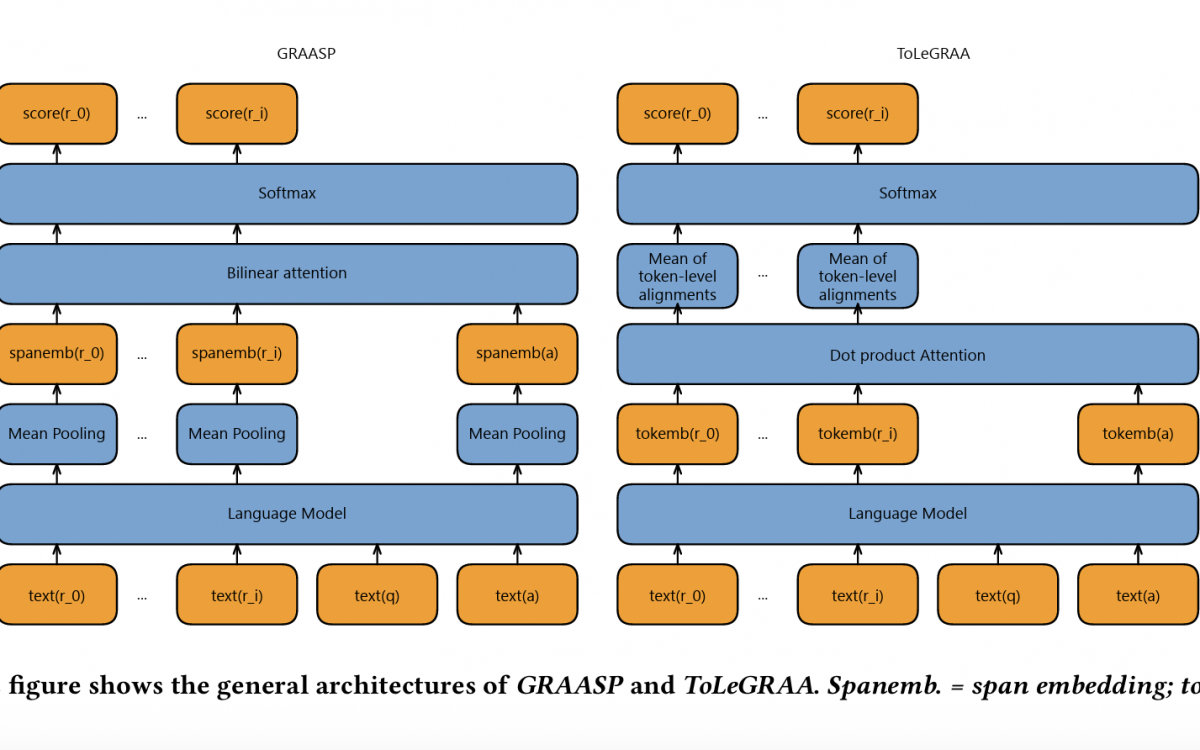
Building on this concept, the paper presents two new transformer-based architectures, GRAASP and ToLeGRAA, which use attention mechanisms to focus on the most relevant rubric information when predicting scores. These architectures aim to make scoring more transparent and more faithful to the assessment design, and they promise greater robustness when tasks change because the scoring logic is driven by the rubric rather than solely by historical training data.

This work aligns with a broader agenda in our group: designing AI systems that are tightly coupled with pedagogical artefacts such as rubrics, feedback guidelines, and learning objectives, instead of treating AI as a detached black box. By placing rubrics at the centre of the modelling process, this research opens a path towards more interpretable, educator-aligned automatic assessment tools that can better support teaching and learning.

Check it here (Open Access PDF via ACM):

Gombert, S., Sun, Z., Zehner, F., Lossjew, J., Wyrwich, T., Czinczel, B. K., Bednorz, D., Kubsch, M., Di Mitri, D., Neumann, K., & Drachsler, H. (2026). Are rubrics all you need? Towards rubric-based automatic short answer scoring via guided rubric-answer alignment. Proceedings of the LAK26: 16th International Learning Analytics and Knowledge Conference, 272–282. https://dl.acm.org/doi/10.1145/3785022.3785064

CategoriesJournal article

New pub: Through the Telescope: A Systematic Review of Intelligent Tutoring Systems

The systematic literature review led by Gianluca Romano has been published in the International Journal of Artificial Intelligence in Education by Springer Nature

"Through the Telescope: A Systematic Review of Intelligent Tutoring Systems and Their Applications in Psychomotor Skill Learning"

This review fits in with our broader effort as a group on how AI can be supportive for psychomotor skills, i.e. those skills which require mind-body coordination, and that have a high degree of physicality.

The article systematically reviews "Intelligent Tutoring Systems (ITS)" and finds that current ITS primarily support fine, simple, and technical skills, such as those in medical and sports training.

We highlight gaps in addressing complex, gross, and open skills. For the future of the field, we call for ITS to incorporate broader physical skill dimensions, personalised feedback, and training theories to achieve more effective, holistic skill development. In the future, we expect ITS to move beyond repetition and expert comparison toward adaptive, theory-driven learning support.

Check it here Open Access 🔓

Romano, G., Schneider, J., Di Mitri, D. et al. Through the Telescope: A Systematic Review of Intelligent Tutoring Systems and Their Applications in Psychomotor Skill Learning. Int J Artif Intell Educ (2025). https://link.springer.com/article/10.1007/s40593-025-00526-1

CategoriesCall for ProposalsWorkshops

CfP Advances in Neural and Hybrid Architectures for Education workshop

🌐 Special Session Announcement — IEEE WCCI 2026

We are pleased to share that the Special Session “Advances in Neural and Hybrid Architectures for Education” has been accepted within IEEE WCCI 2026, which will take place in Maastricht from 21 to 26 June 2026.

📌 Motivation & Scope
Artificial Intelligence and Neural Networks are increasingly shaping the way we understand and support human learning. Modern educational environments produce large amounts of multimodal and dynamic data—from learner interactions to behavioural and cognitive signals—which can be modelled through neural and hybrid approaches to design intelligent, adaptive, and personalised learning systems.
This Special Session aims to bring together researchers working at the intersection of neural computation, learning analytics, cognitive modelling, and educational technologies. We welcome contributions on deep learning architectures, neuro-symbolic approaches, hybrid reasoning models, explainability in educational AI, affective computing, personalisation strategies, and ethical aspects in human-centred learning systems.

🧭 Topics of Interest include (but are not limited to):
• Neural and hybrid architectures for learning analytics and adaptive education
• Deep learning for learner modeling and performance prediction
• Cognitive and affective modeling in educational contexts
• Personalization and recommendation in intelligent tutoring
• Neuro-symbolic and hybrid reasoning for educational data
• Explainability, fairness, and trust in educational AI
• Multimodal and temporal learning data
• Human-centered design and evaluation of educational AI
• Knowledge graphs and AI for personalization, analytics, and ethics

👥 Organizers
- Hasan Abu-Rasheed (Goethe University Frankfurt)
- Gabriella Casalino (Università degli Studi di Bari )
- Daniele Di Mitri (German University of Digital Science)
- Daniele Schicchi (CNR ITD - Istituto Tecnologie Didattiche)
- Davide Taibi (CNR ITD - Istituto Tecnologie Didattiche)

📅 Paper Submission Deadline
January 31, 2026 (23:59 AoE, UTC-12) — no extension will be given

📄 Full paper: 6 pages, IEEE conference format

🔗 More information: https://lnkd.in/dzuapfYe

CategoriesArtificial Intelligence

What do I think about AGI

A few days ago, I chatted with a clever 16-year-old who, after learning what I do for work, asked me what I think about AGI (artificial general intelligence). I explained that I see AGI primarily as a cult, a narrative constructed by Silicon Valley actors that masks what is fundamentally about profit accumulation and power consolidation behind the veneer of building a "supernatural intelligence".

In the last few weeks, I have been avidly reading Karen Hao's book, Empire of AI, which articulates these mechanisms with clarity. A book I suggest everyone read to learn more about the current philosophy of scale, extraction, and technological imperialism, pioneered by Sam Altman and OpenAI.

I mentioned something the book emphasises: the hidden costs of generative AI that we systematically ignore. We imagine generative AI as a weightless technology floating in the cloud, at our fingertips and available whenever we want. Yet, we overlook its profound materiality and its devastating impact on marginalised communities.

I shared the example of data annotators in Kenya and Venezuela who are forced to process disturbing AI-generated content material describing violence and atrocities. Their psychological toll is real: many of these workers have developed post-traumatic stress and other serious mental health consequences. Their labour remains invisible, yet it is essential to every generative AI system we use.

The teenager was surprised. "Nobody talks about this", he said. "What you hear about is the existential threat, the futuristic - robots-taking-over-the-world - scenarios." His observation aligns with what Empire of AI argues: certain fictitious narratives about AI are deliberately amplified to obscure the real stories of people and natural resources consumed under the heavy weight of these technologies.

Then came his most honest admission: he uses GenAI in school, as do all his classmates. This confession did not really surprise me. Even if he feels it's making him intellectually dumber, he continues anyway.

This resonated with something I'd recently read: that educational institutions have a responsibility to prevent deskilling. Yet that's precisely what's happening with generative AI.

The question that haunts me now is how we cultivate critical thinking when the very tools designed to assist us are eroding our capacity to think independently. How do we resist a technology that promises convenience while dismantling the intellectual resilience we need?