
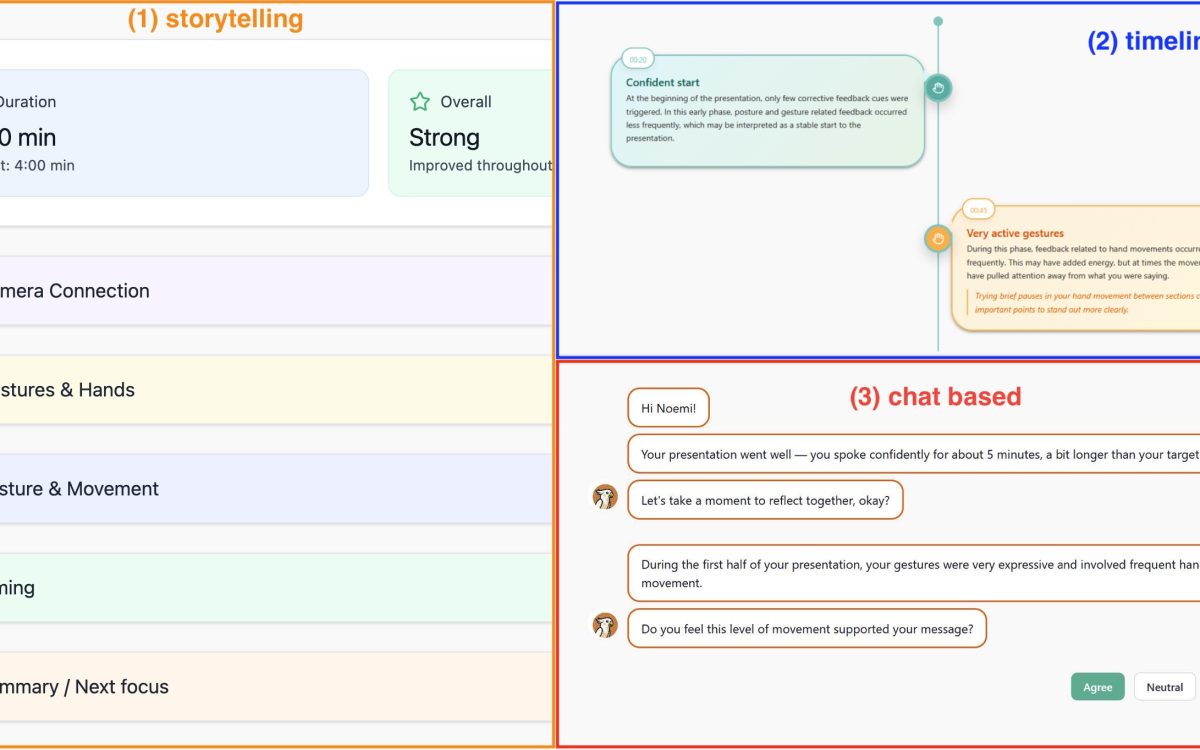
The paper, Structured over Chat-Based Feedback: Comparing User Preferences on Different Presentation Feedback Reports, by Noemi Giulia Bontempo, Nina Mouhammad and Daniele Di Mitri, explores how learners prefer to review feedback after practising a presentation, focusing on a question that receives less attention than immediate coaching: how should feedback be presented once the rehearsal is over?
Digital presentation-training systems can provide feedback on delivery behaviours such as posture, gestures and orientation towards the camera or audience. But during a presentation, learners are already managing their content and delivery. A report after the rehearsal offers another opportunity: to revisit performance and reflect on what to improve. We compared three ways to support that process in Presentable: a timeline that links feedback to moments in the presentation, a chat-based conversation with a virtual coach, and a storytelling-style report organised into themes such as gestures, posture and camera connection.
We evaluated the three designs in an online study with 84 participants. Everyone reviewed all three versions, which used the same fictional rehearsal scenario and feedback content. This allowed us to compare the presentation of feedback rather than differences in the feedback itself. Participants rated each design and compared its perceived clarity, usefulness, support for reflection and potential to help them understand their performance.
The two structured designs were rated more positively overall than the chat-based report. The timeline was selected as most helpful overall by 48% of participants, while 40% chose the storytelling design and 12% chose the chat design. The timeline was particularly valued for showing when behaviours occurred. The storytelling design was selected most often as easiest for understanding presentation performance, by 49% of participants.
Participants also highlighted the design elements they found useful for reflection: clear visual grouping of categories (73%), highlighting key moments (61%), and making the connection between feedback and time clear (55%). Some appreciated the chat’s personal and interactive feel, but others found it harder to get an overview, compare feedback points or return to specific items.
For us, the findings suggest that conversational presentation alone does not necessarily make feedback easier to use. When learners review a rehearsal, clear organisation and context matter: they need to see what happened, when it happened and how different observations fit together. The results also point towards a promising next step: combining the timeline’s moment-by-moment detail with the storytelling design’s readable thematic overview.
We interpret these results as design insights, not evidence that one report format improves presentation skills. Participants assessed mock-ups based on a fictional scenario; they did not use the reports after delivering their own presentations. Our next step is to integrate the Rehearsal Report into Presentable and connect feedback items to the corresponding moments in a learner’s recording, enabling evaluation in real practice sessions.
Citation: