The latest paper led by Sebastian Gombert has been published in the Proceedings of the LAK26: 16th International Learning Analytics and Knowledge Conference (LAK26).
"Are rubrics all you need? Towards rubric-based automatic short answer scoring via guided rubric-answer alignment"
In educational assessment, rubrics are central because they define clear criteria for evaluating learner responses and specify what counts as relevant evidence. Yet, most automatic short answer scoring approaches make little to no explicit use of rubrics, or treat them only as additional side information. This paper turns that around and asks what happens if rubrics themselves become the primary scoring reference for automated systems.
The authors introduce the task of rubric-based automatic short-answer scoring, in which the model uses the scoring rubric as an explicit anchor rather than relying solely on large sets of labelled student responses. To implement this idea, they propose a guided rubric–answer alignment, in which each student's answer is aligned directly with rubric criteria and level descriptors rather than with other answers.
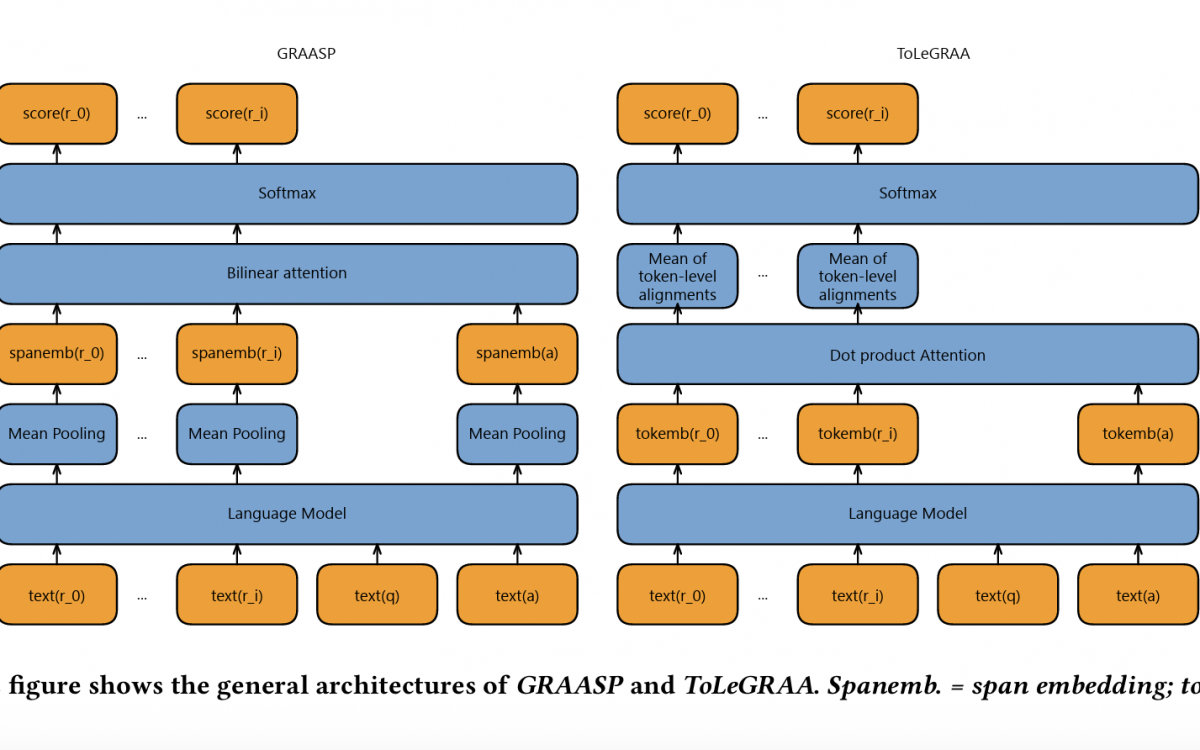
Building on this concept, the paper presents two new transformer-based architectures, GRAASP and ToLeGRAA, which use attention mechanisms to focus on the most relevant rubric information when predicting scores. These architectures aim to make scoring more transparent and more faithful to the assessment design, and they promise greater robustness when tasks change because the scoring logic is driven by the rubric rather than solely by historical training data.
This work aligns with a broader agenda in our group: designing AI systems that are tightly coupled with pedagogical artefacts such as rubrics, feedback guidelines, and learning objectives, instead of treating AI as a detached black box. By placing rubrics at the centre of the modelling process, this research opens a path towards more interpretable, educator-aligned automatic assessment tools that can better support teaching and learning.
Check it here (Open Access PDF via ACM):
Gombert, S., Sun, Z., Zehner, F., Lossjew, J., Wyrwich, T., Czinczel, B. K., Bednorz, D., Kubsch, M., Di Mitri, D., Neumann, K., & Drachsler, H. (2026). Are rubrics all you need? Towards rubric-based automatic short answer scoring via guided rubric-answer alignment. Proceedings of the LAK26: 16th International Learning Analytics and Knowledge Conference, 272–282. https://dl.acm.org/doi/10.1145/3785022.3785064