What should students learn to do themselves when generative AI can produce so much for them? And how can we understand what they have actually learned when the final assignment may have been created with substantial AI support?
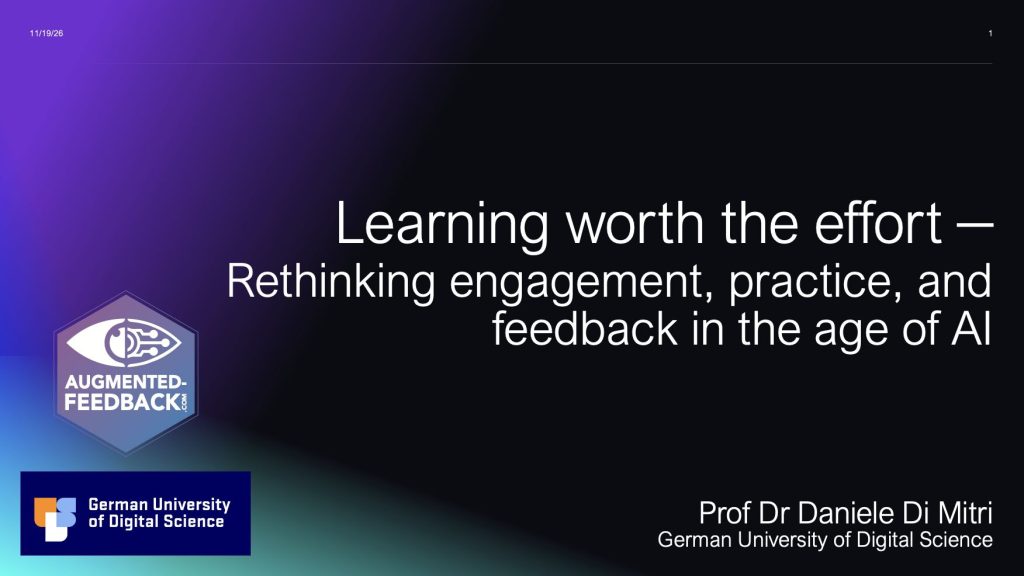
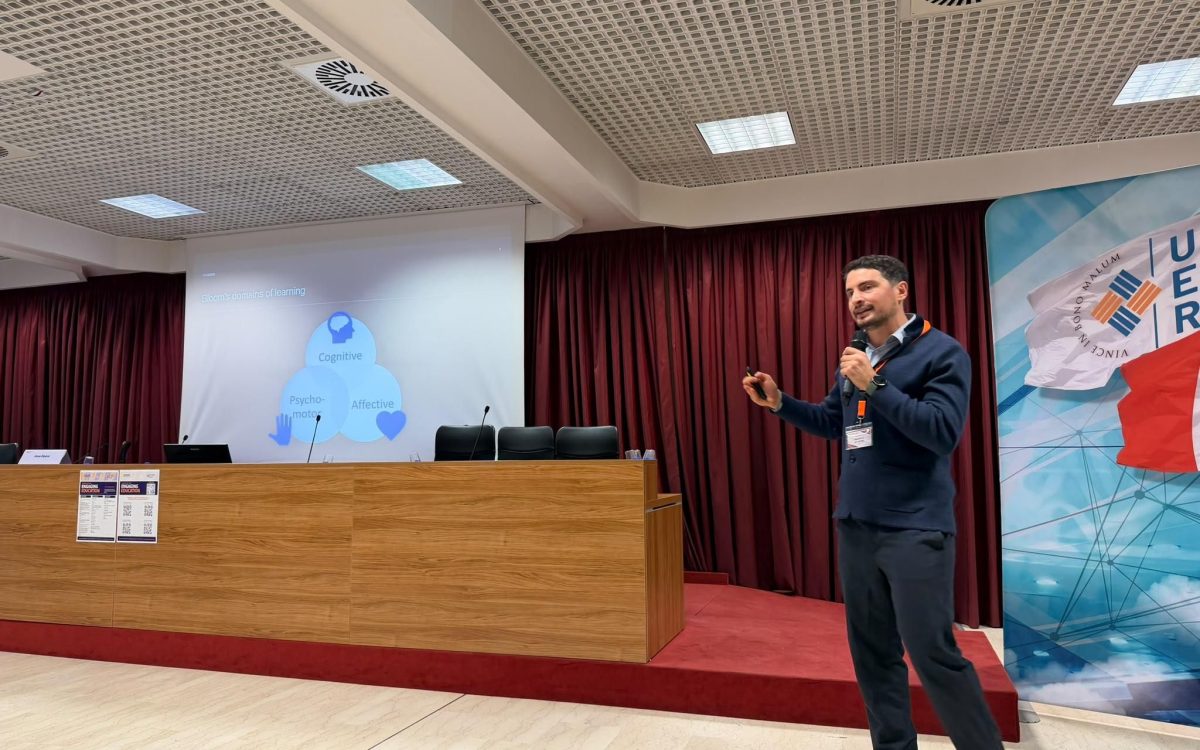
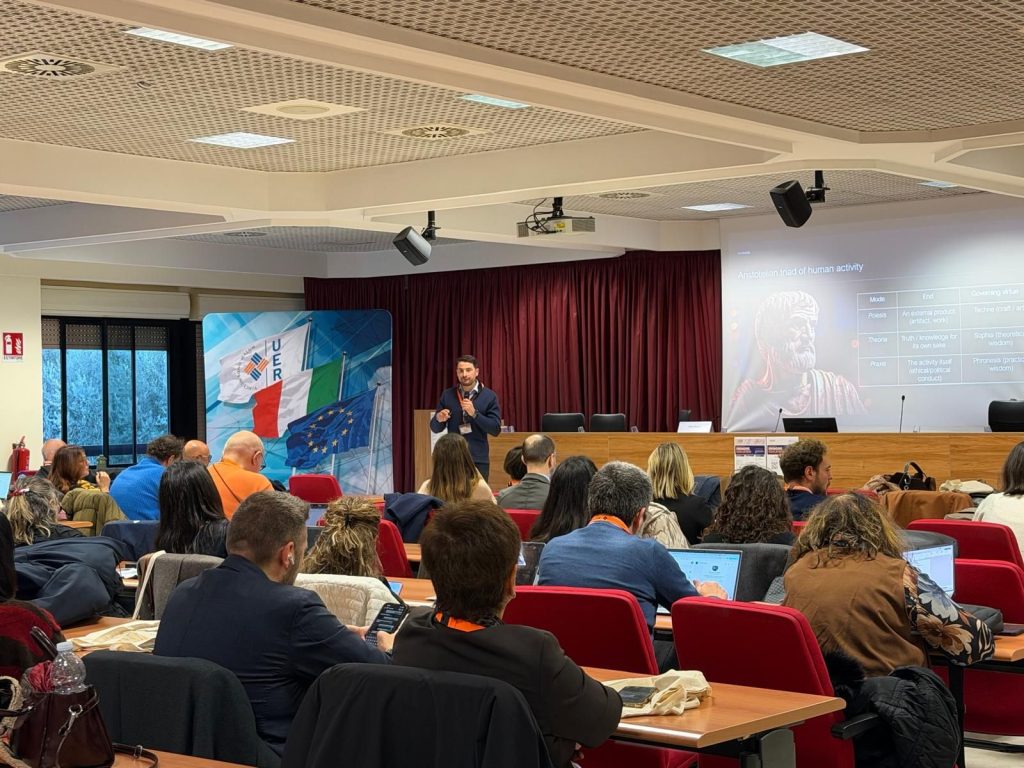
These were the starting questions of my keynote on engagement, practice, and feedback in the age of AI which I delivered for the annual congress of SIREM - the Italian association on media education. The congress focused on the overarching theme "engaging education" and took place 19-21th November 2026 at the European University of Rome (UER).
I approached the questions through my research on psychomotor learning and complex skills, particularly public speaking. This perspective makes an important distinction visible: helping someone produce a good result does not necessarily help them develop the ability to achieve it.
The question is therefore broader than whether students should use AI. It concerns which activities remain educationally valuable, what learners need to experience personally, and where technology can support that process without taking it over.
At a digital university such as the German University of Digital Science, these questions are especially relevant. Students participate from different parts of the world, making it difficult to find common times for live teaching. Asynchronous materials and activities provide flexibility, while virtual campus spaces create additional opportunities to meet and interact.
But neither flexible access nor an immersive campus resolves the assessment question. A polished essay or presentation tells us something about the submitted work. It tells us less about how the student arrived there, which decisions they made, or what they can now do independently.
This invites a shift in attention towards the learning process: attempts, revisions, explanations, feedback, and subsequent performance. The purpose is to understand how capabilities develop
To take a step back from the technology, building up on the observation made by Francesco Balzan in his recent PhD thesis, I drew on Gert Biesta’s three domains of educational purpose: qualification, socialisation, and subjectification. Qualification concerns knowledge and skills; socialisation concerns participation in existing practices, cultures, and traditions. Subjectification concerns the student’s existence as a subject of their own life, able to act rather than simply be acted upon.
The third dimension is particularly important for the argument I wanted to make. Education should leave room for learners to exercise judgement, respond to the world, and decide how to act. That is more demanding than producing the expected answer.
In presentation training, this means helping people develop their own voice while learning to respond to an audience and a communicative situation. A technically polished performance is not the only educational goal.
I also used Aristotle’s distinction between poiesis, production directed towards an external outcome, and praxis, action whose end lies in the activity itself.
I brought this distinction into the talk as a way of questioning our emphasis on educational products. AI can help produce a text, a slide deck, or a script. Yet the existence of that product does not establish that its author has developed the understanding or judgement involved in creating it.
This does not mean that producing things has no educational value. Making, testing, and revising an artefact can be central to learning. The central point remains is which parts of that work the learner needs to undertake personally, and which forms of assistance support rather than bypass their development.
Another reference was bell hooks’ engaged pedagogy. Her work challenges an educational culture that treats intellectual activity as separate from bodies, lived experience, and relationships. In Teaching to Transgress, her dialogue with Ron Scapp connects teaching with the presence of the whole person and with a willingness to question one’s own pedagogical practices.
For my talk, this offered a useful way to think about engagement beyond attention or entertainment. Learning can be enjoyable, but it can also involve uncertainty, frustration, and the discomfort of reconsidering an assumption.
The aim should not be to make every activity effortless. Nor should difficulty become a virtue in itself. I am interested in preserving challenges that serve a learning purpose, while providing enough support for students to work through them.
That support also depends on teachers’ wellbeing. An educational environment cannot attend seriously to learners as whole people while ignoring the people responsible for teaching them.
Public speaking, sport, craft, and clinical practice bring together knowledge, movement, decisions, and emotions. They are situated activities: knowing what to do in the abstract is different from doing it in a particular setting.
This is why I find complex skill learning a useful starting point for thinking about AI in education. A learner cannot develop presentation skills solely by reading a convincing account of how to present. They need opportunities to speak, notice what happens, receive feedback, and try again.
In the talk, I discussed deliberate practice as a structured approach to improvement. Rather than repeating the same performance without direction, learners work towards specific goals, attend to selected aspects of their performance, and use feedback to guide subsequent attempts.
Frequent, individualised coaching is difficult to provide at scale. This is where AI-supported environments can have a useful role.
As a working example, I introduced Presentable , a web-based environment for presentation training. It offers immediate feedback on aspects of voice and body language, alongside retrospective feedback that learners can review after rehearsing.
The educational aim is to help people practise presenting, rather than generate a presentation on their behalf.
But public speaking also exposes the limits of automated judgement. A gesture, pause, or change in pace cannot always be classified as universally right or wrong. Its appropriateness depends on the topic, audience, context, and speaker’s intentions.
This makes authenticity an important design concern. Feedback should help learners expand their communicative possibilities without pushing everyone towards the same standardised performance. Teacher interpretation and learner judgement remain part of that process.
One lesson I highlighted is that producing feedback receives much more attention than helping learners use it.
A comment can be accurate yet difficult to act upon. A learner may understand that they speak too quickly without knowing how to practise a different pace. Another may receive a useful observation but feel discouraged or become overly self-conscious.
This is why feedback literacy matters: learners need opportunities to interpret comments, evaluate their relevance, and translate them into manageable changes.
For an AI tutor, the design problem therefore extends beyond detecting a behaviour and generating a message. It includes deciding what matters now, when to intervene, and what the learner can do next. It also includes knowing when additional feedback would distract from the task rather than support it.
The conclusion of the talk was that engaging AI-supported education begins before feedback is generated. It begins with decisions about what is worth learning, which tasks learners should undertake, how practice should progress, and where support is needed.
For complex skills, that means connecting instruction, practice, assessment, feedback, and reflection. It also means preserving space for learners to make choices, test their understanding, and develop an authentic way of acting.
AI can contribute to this work, but its appropriate role depends on the educational purpose. Sometimes it should explain or prompt. Sometimes it should help learners review an attempt. Sometimes the most useful design decision may be to withhold assistance.
***