
We are pleased to share our newly published paper, Educator as Co-pilot: Advancing Presentation Training with Teacher-guided Systems. The work grew out of Talha Burak Onat’s master’s thesis at Goethe University Frankfurt, conducted in collaboration with DIPF | Leibniz Institute for Research and Information in Education.
Presentation-training platforms can give students opportunities to rehearse and receive automated feedback on their verbal and non-verbal communication. But automated analysis cannot always account for context or the learning goals of a particular presentation. We wanted to explore how teachers could add that human perspective: interpreting feedback, offering guidance, and helping students decide what to work on next. This concept has since shaped the current approach used by Presentable (www.presentable.info), where automated analysis is complemented by teacher guidance.
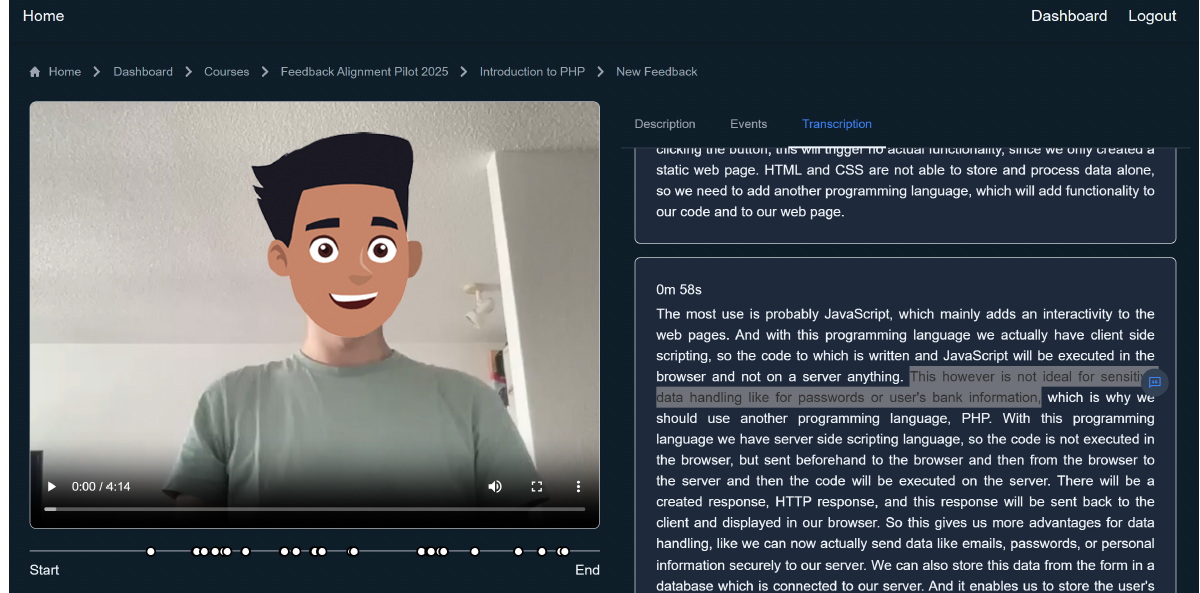
To investigate this, we designed and evaluated a teacher-feedback feature for Presentable, a web-based presentation-training platform. It enables educators to write structured comments using templates, link feedback to specific moments in a video, annotate transcript passages, and validate or reject automated feedback before students see it. Students and teachers can also exchange replies, making feedback an ongoing conversation rather than a one-way report.
We explored the tool through interviews with four educators: two secondary-school teachers and two university-level tutors. They generally found the interface clear and valued the templates, timestamp-linked comments and transcript annotations. These functions helped connect feedback to specific parts of a presentation, while written comments and asynchronous discussion offered ways for students to revisit and clarify advice.
The interviews also showed us where the design needs further work. Educators asked for draft-saving and autosave, clearer access to transcript comments, and the ability to edit submitted feedback. Their views on automated feedback were mixed: some messages drew attention to presentation behaviours, while others felt trivial or unrelated to assessment criteria. This reinforced an important point for us: automated feedback needs to be relevant and useful in context, and teachers need the means to review it.
We see the paper as an early step towards presentation-training systems in which automation supports, rather than replaces, educators’ expertise. Our evaluation involved a small group, so it offers initial design insights, not evidence of improved student performance. Further studies with larger and more varied groups will be needed to examine how teacher-guided feedback affects learning over time.
We are especially glad that this publication brings work from Burak’s master’s thesis into a broader conversation about human-centred educational technology. It shows how a thesis project can move from identifying a practical gap, through designing and evaluating a solution, to informing the next stage of a research platform.
Citation:
Di Mitri, D., Onat, T.B. (2026). Educator as Co-pilot: Advancing Presentation Training with Teacher-Guided Systems. In: Adamoli, M., et al. Higher Education Learning Methodologies and Technologies Online. HELMeTO 2025. Communications in Computer and Information Science, vol 2958. Springer, Cham. https://doi.org/10.1007/978-3-032-31850-3_28